Liturgical Calendar & Feasts
Nativity of Christ (Christmas)
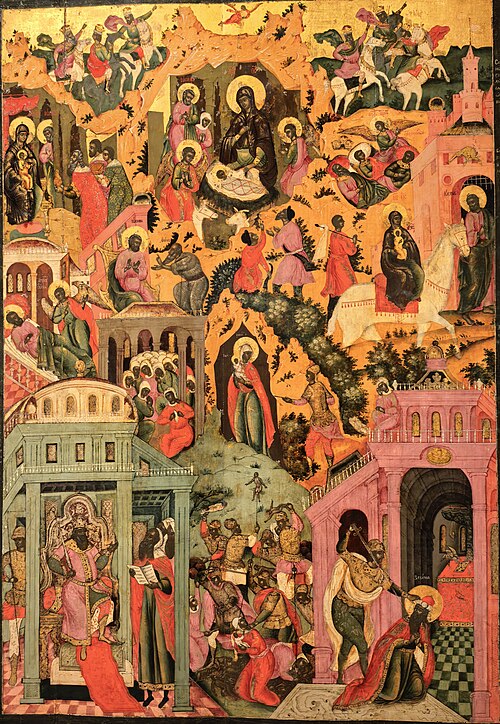
The birth of Christ, kept on 25 December, which on the Old Calendar falls on 7 January. The East kept it with the Theophany until the end of the fourth century; St John Chrysostom was preaching the separate feast at Antioch in 386 as recently arrived. It is prepared for by forty days of fasting from 15 November, and on the eve, strictly kept, the Royal Hours are read and the Liturgy of St Basil is served with Vespers. Its kontakion, St Romanos’, says what the feast is: today the Virgin gives birth to Him who is above all being, and the earth offers a cave to the Unapproachable. The icon holds the whole mystery. The Child lies in a manger shaped like a tomb and wrapped like the dead; the ox and the ass of Isaiah know their Master’s crib; the Theotokos rests beside Him; and in a corner St Joseph sits troubled, while an old man tempts him to doubt.
Sources
- Menaion (December) the OCA calendar
- St. Gregory the Theologian, Oration 38 (On the Theophany/Nativity) NPNF
- St. Romanos the Melodist, Kontakion on the Nativity
- St. John Chrysostom, Homily on the Nativity (386) CCEL, the Fathers
- Isaiah 1:3 the Septuagint
Connections
- Annunciation: March 25
- Fasting
- Liturgy of St. Basil the Great
- Meeting of the Lord (Hypapante): February 2
- St. Gregory the Theologian (329-390)
- St. John Chrysostom (c. 349-407)
- St. Romanos the Melodist (c. 490-556)
- St. Stephen the Protomartyr
- The Incarnation
- The Nativity Fast
- The Twelve Prophets
- Theophany (Epiphany): January 6
In the calendar: 25 December