Councils and Their Canons
Sixth Ecumenical Council: Constantinople III (680-681)
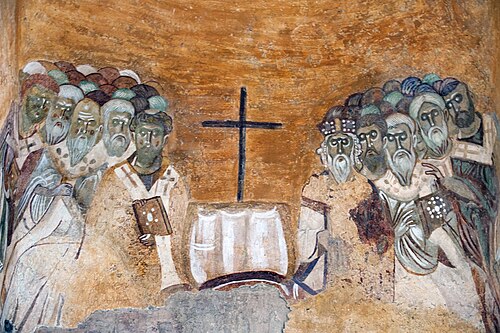
Convened by the Emperor Constantine IV and held in the domed hall of the imperial palace. It condemned Monothelitism and the single operation that went with it, and defined that Christ has two natural wills and two natural operations, without division, without change, without separation and without confusion, His human will following the divine not as resisting or reluctant but as subject to it. The argument is St. Maximus the Confessor's: a will belongs to a nature and not to a person, so a Christ with no human will would not be a man, and what He did not assume He did not heal. Gethsemane is the text it rests on, where the Lord prays that not His will but the Father's be done, and prays it with a human will that wants to live. It condemned Sergius, Pyrrhus, Paul and Peter of Constantinople, Cyrus of Alexandria, Theodore of Pharan and Pope Honorius of Rome, whose condemnation Pope Leo II then confirmed; an Ecumenical Council judging a pope for heresy is among the plainest Orthodox answers to the later claim of personal infallibility. St. Maximus and Pope St. Martin I had both died in exile for this confession and neither lived to see it received. It issued no canons of its own, and the Quinisext Council supplied them eleven years later.
Sources
- Acts of the Sixth Ecumenical Council (Constantinople III, 680-681 AD) the Acts, NPNF
- Definition of Faith of the Sixth Ecumenical Council (Constantinople III, 681) the Acts, NPNF
- St. Maximus the Confessor, Disputation with Pyrrhus
- St. Maximus the Confessor, Opuscula Theologica
- St. Gregory the Theologian, Epistle 101 (to Cledonius) NPNF
- Matthew 26:39 the Greek New Testament