Theology & Dogma
Christology
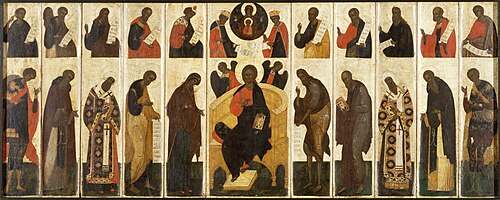
Who Christ is, as the councils defined it over four hundred years: one Person, the eternal Son, in two complete natures, divine and human, united without confusion, without change, without division, without separation. Every clause of that sentence answers someone. Nestorius divided Christ into God and a man joined to Him, and Ephesus in 431 answered that the one born of the Virgin is God, so she is Theotokos. Eutyches let the humanity dissolve into the divinity, and Chalcedon in 451 answered with the four adverbs. The monothelites gave Christ one will, and the Sixth Council in 681, following St Maximus, answered that each nature has its own will and activity, the human freely obeying the divine. Because the Person is one, what belongs to either nature can be said of Him: God was crucified, and a man is worshipped. The Oriental churches that did not receive Chalcedon remain apart, and the dialogue with them has not ended in reunion.
Sources
- Third Ecumenical Council (431 AD) the Acts, NPNF
- The Formula of Reunion (433 AD)
- Fourth Ecumenical Council (451 AD), the Definition of Faith
- Sixth Ecumenical Council (680-681 AD), the Definition the Acts, NPNF
- St. Cyril of Alexandria, On the Unity of Christ the Ephesus documents
- St. Maximus the Confessor, Opuscula Theologica et Polemica
Connections
- Ascension of Christ
- Christ Pantocrator (Icon Type)
- Exact Exposition of the Orthodox Faith
- Fifth Ecumenical Council: Constantinople II (553)
- Fourth Ecumenical Council: Chalcedon (451)
- Hypostasis (Person)
- Kenosis (The Self-Emptying)
- Monophysitism
- Monothelitism
- Nestorianism
- Ousia (Essence/Nature)
- Perichoresis (Mutual Indwelling)
- Sixth Ecumenical Council: Constantinople III (680-681)
- St. Cyril of Alexandria
- St. Gregory the Theologian (329-390)
- St. Leo the Great, Pope of Rome
- St. Maximus the Confessor (c. 580-662)
- The Incarnation
- The Oriental Orthodox Churches
- Third Ecumenical Council: Ephesus (431)