Eschatology & Afterlife
The Aerial Toll Houses
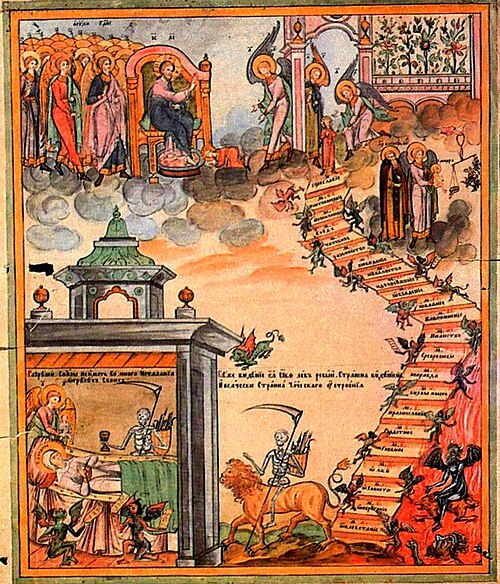
An account of what the soul meets after death: a passage upward through the air in which demons bring accusations, sin by sin, and the angels who lead the soul answer with what has been repented of. Its oldest witness is St Athanasius, who tells how St Antony, caught up in prayer, saw himself led through the air while bitter and terrible beings stood in the way and demanded an account of his life. It is told most fully in the Life of St Basil the New, where the Blessed Theodora describes passing twenty toll houses, and the Church prays it at every Saturday Midnight Office in the words of the martyr Eustratius, printed below. A homily on the departure of the soul sets it out at length and was long printed in the Slavonic Psalter under the name of St Cyril of Alexandria, though it is not his; in the nineteenth century St Ignatius Brianchaninov and St Theophan the Recluse defended it, St Theophan warning that however absurd the toll houses seem to the wise of this world, they will not escape passing through them. It is also seriously contested inside the Church, and both things are true. No council has defined it, no Creed mentions it, and Orthodox theologians disagree about how far it is a vision given in the language of visions. This site records it as a strong strand of the tradition, not a dogma, and not a thing anyone is required to picture.
…he stood and saw himself, as it were, from outside himself, and that he was led in the air by certain ones. Next certain bitter and terrible beings stood in the air and wished to hinder him from passing through.
The text
The Prayer of St Eustratius
And now, O Master, let Thy hand shelter me and let Thy mercy come upon me, for my soul is troubled and in anguish as it goes out of this my wretched and defiled body, lest the evil counsel of the adversary meet it and hinder it, because of the sins I have committed in this life, in ignorance and in knowledge.
Be merciful to me, O Master, and let not my soul see the gloomy and dark face of the evil demons, but let Thy bright and shining angels receive it.
Give glory to Thy holy name, and by Thy power lead me up to Thy divine judgement seat. When I am judged, let not the hand of the ruler of this world seize me, to drag me, a sinner, down into the depth of Hades; but stand by me, and be my saviour and my helper.
Καὶ νῦν, Δέσποτα, σκεπασάτω με ἡ χείρ σου καὶ ἔλθοι ἐπ’ ἐμὲ τὸ ἔλεός σου, ὅτι τετάρακται ἡ ψυχή μου καὶ κατώδυνός ἐστιν ἐν τῷ ἐκπορεύεσθαι αὐτὴν ἐκ τοῦ ἀθλίου μου καὶ ῥυπαροῦ σώματος τούτου, μή ποτε ἡ πονηρὰ τοῦ ἀντικειμένου βουλὴ συναντήσῃ καὶ παρεμποδίσῃ αὐτήν, διὰ τὰς ἐν ἀγνοίᾳ καὶ γνώσει ἐν τῷ βίῳ τούτῳ γενομένας μοι ἁμαρτίας.
Ἵλεως γενοῦ μοι, Δέσποτα, καὶ μὴ ἰδέτω ἡ ψυχή μου τὴν ζοφερὰν καὶ σκοτεινὴν ὄψιν τῶν πονηρῶν δαιμόνων, ἀλλὰ παραλαβέτωσαν αὐτὴν Ἄγγελοί σου φαιδροὶ καὶ φωτεινοί.
Δὸς δόξαν τῷ ὀνόματί σου τῷ ἁγίῳ, καὶ τῇ σῇ δυνάμει ἀνάγαγέ με εἰς τὸ θεῖόν σου βῆμα. Ἐν τῷ κρίνεσθαί με μὴ καταλάβοι με ἡ χεὶρ τοῦ ἄρχοντος τοῦ κόσμου τούτου εἰς τὸ κατασπάσαι με τὸν ἁμαρτωλὸν εἰς βυθὸν ᾅδου, ἀλλὰ παράστηθί μοι, καὶ γενοῦ μοι σωτὴρ καὶ ἀντιλήπτωρ.
Said at the Midnight Office on Saturdays, and by tradition the prayer of the martyr Eustratius before his death. The English is this site’s own translation of the Greek.
Sources
- The Life of St. Basil the New (the vision of the Blessed Theodora)
- St. Ignatius Brianchaninov, The Arena archive.org, to borrow
- St. John Chrysostom, Homily 2 on Lazarus CCEL, the Fathers
- The Menaion, 26 March the OCA calendar
- St. Athanasius, The Life of Antony 65 NPNF
- The Horologion, the Midnight Office of Saturday (the Prayer of St. Eustratius) OCA, the services
- St. Ignatius Brianchaninov, Homily on Death (1863) archive.org, to borrow
- St. Theophan the Recluse, Commentary on Psalm 118 (as quoted in Fr. Seraphim Rose, The Soul After Death) azbyka.ru, his works in Russian
- Fr. Seraphim Rose, The Soul After Death (2009)