Liturgy & Worship
The Akathist Hymn
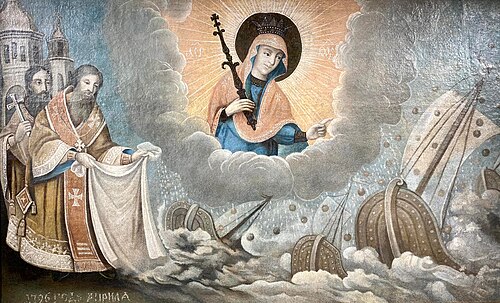
The most famous and beloved hymn of the Orthodox Church, dedicated to the Theotokos. An 'akathist' means 'not seated': the congregation stands throughout. Composed in the 5th-6th century (attributed variously to St. Romanos or Patriarch Sergius). Chanted in full during the 5th Saturday of Great Lent and at other times. Contains 24 stanzas alternating 'Rejoice' invocations.
The text
The kontakion, and the refrain
To thee, the Champion Leader, do I thy City ascribe the prize of victory and the thanksgiving of one rescued from peril, O Theotokos;
but as thou art she who hast the might invincible, from every danger set me free, that I may cry to thee: Hail, Bride unwedded.
Τῇ ὑπερμάχῳ στρατηγῷ τὰ νικητήρια, ὡς λυτρωθεῖσα τῶν δεινῶν εὐχαριστήρια ἀναγράφω σοι ἡ Πόλις σου, Θεοτόκε·
ἀλλ᾽ ὡς ἔχουσα τὸ κράτος ἀπροσμάχητον, ἐκ παντοίων με κινδύνων ἐλευθέρωσον, ἵνα κράζω σοι· Χαῖρε, Νύμφη ἀνύμφευτε.
The hymn runs to twenty-four stanzas, one for each letter of the Greek alphabet, and is far too long to set here. These are the two parts everybody knows: the kontakion that opens it, sung by Constantinople in 626 after the siege lifted, and the salutation that ends every other stanza.
Sources
- Triodion (Lenten liturgical book: contains the full Akathist) archive.org, to borrow
- St. Romanos the Melodist, Kontakion on the Annunciation (model for the Akathist)
- Menaion (December 9: Conception of the Theotokos, context for Akathist origins) the OCA calendar