Theology & Dogma
Theotokos (Mother of God)
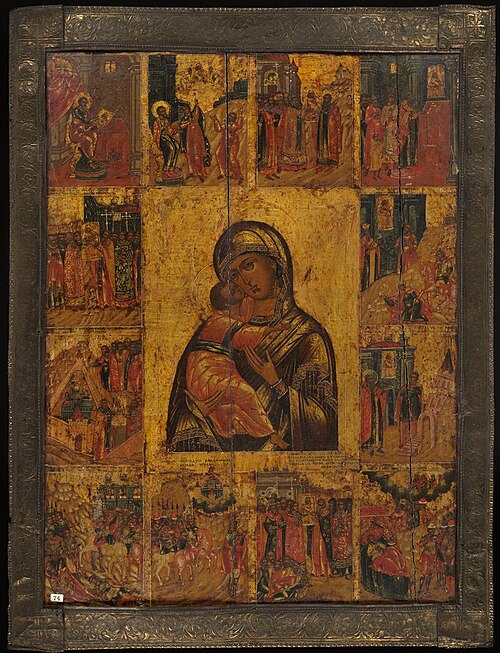
The Mother of God, the title the Third Ecumenical Council confirmed at Ephesus in 431: the One she bore is God, and to call her less is to divide her Son. The Church calls her ever-virgin, and in the litanies of almost every service our most holy, most pure, most blessed and glorious Lady, and asks her prayers more often than those of anyone else. The Fathers from Justin and Irenaeus on called her the new Eve, whose obedience undid the first Eve’s disobedience, and St Nicholas Cabasilas wrote that the Incarnation was the work not only of the Father, the Son and the Spirit but of the will and faith of the Virgin. The Church keeps her Dormition as a true death followed by her translation into heaven, body and soul, sung in the hymns of the feast without being defined as a dogma; it does not receive the Latin dogma of her Immaculate Conception, because it never taught the inherited guilt from which that dogma exempts her. Her icon stands to the left of the royal doors, and in the apse above the altar she is often painted as the Platytera, wider than the heavens, holding Christ.
The text
Axion Estin
It is truly meet to bless thee, O Theotokos, ever blessed and most pure, and the Mother of our God.
More honourable than the Cherubim, and beyond compare more glorious than the Seraphim, who without corruption gavest birth to God the Word, true Theotokos, we magnify thee.
Ἄξιόν ἐστιν ὡς ἀληθῶς μακαρίζειν σε τὴν Θεοτόκον, τὴν ἀειμακάριστον καὶ παναμώμητον καὶ μητέρα τοῦ Θεοῦ ἡμῶν.
Τὴν τιμιωτέραν τῶν Χερουβὶμ καὶ ἐνδοξοτέραν ἀσυγκρίτως τῶν Σεραφίμ, τὴν ἀδιαφθόρως Θεὸν Λόγον τεκοῦσαν, τὴν ὄντως Θεοτόκον, σὲ μεγαλύνομεν.
The hymn to the Theotokos at the Liturgy, after the consecration. The second half is older than the first and is St Cosmas the Melodist’s, the heirmos of the ninth ode of his canon for Great Friday.
Sources
- Council of Ephesus (431 AD) the Acts, NPNF
- St. Cyril of Alexandria, Letters to Nestorius the Ephesus documents
- Liturgy of St. John Chrysostom (Axion Estin hymn) CCEL, the Fathers
- St. Justin Martyr, Dialogue with Trypho 100 ANF
- St. Irenaeus of Lyons, Against Heresies III.22.4 ANF
- St. Nicholas Cabasilas, Homily on the Annunciation
- The Menaion, 15 August the OCA calendar
Connections
- Annunciation: March 25
- Dormition of the Theotokos: August 15
- Entry of the Theotokos into the Temple: Nov 21
- Fifth Ecumenical Council: Constantinople II (553)
- Meeting of the Lord (Hypapante): February 2
- Mount Athos (Holy Mountain)
- Nativity of the Theotokos: Sept 8
- Nestorianism
- Orthros / Matins (Morning Service)
- Patristic Typology
- Recapitulation (Anakephalaiosis)
- Ss. Joachim and Anna, the Ancestors of God
- St. Cyril of Alexandria
- St. Germanus of Constantinople
- St. Irenaeus of Lyon (c. 130-202)
- St. James, the Brother of the Lord
- St. John Koukouzelis
- St. John the Theologian (the Evangelist)
- St. Justin Martyr (c. 100-165)
- St. Mary of Egypt
- St. Nicholas Cabasilas
- The Akathist Hymn
- The Deesis
- The Hodegetria (She Who Shows the Way)
- The Iconostasis
- The Incarnation
- The Paraklesis (Supplicatory Canon)
- The Proskomedia (Preparation of the Gifts)
- The Protection of the Theotokos: October 1
- The Theotokos and the Immaculate Conception
- Theotokos Icon Types
- Third Ecumenical Council: Ephesus (431)
In the calendar: 26 December