Liturgical Calendar & Feasts
Pascha (Easter)
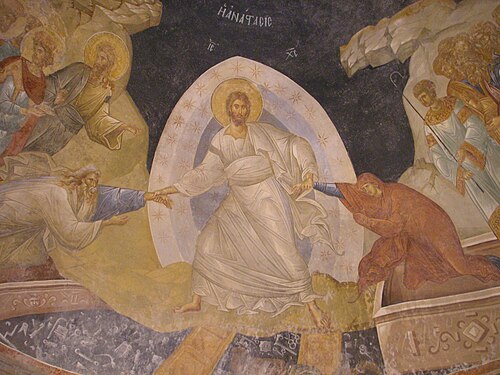
The Resurrection of Christ, the feast of feasts, and the day every Sunday of the year repeats. At Nicaea the Fathers asked that the whole Church keep it on one Sunday, reckoned independently of the Jewish calendar; the Orthodox Church still finds that Sunday by the Julian calendar and the old Alexandrian tables, which is why it usually falls later than Easter in the West and sometimes on the same day. In the dark before midnight the light is brought out from the altar and passed from candle to candle, the people go out in procession, and outside the church the troparion is sung for the first time. For forty days the greeting is Christ is risen, and the answer Truly He is risen, and the troparion takes the place of O Heavenly King at the opening of every service. The week that follows is kept as a single day, with the royal doors left open, and St John Chrysostom’s homily, read that night, calls everyone to the feast, those who fasted and those who did not.
The text
The Paschal troparion
Christ is risen from the dead, trampling down death by death, and upon those in the tombs bestowing life.
Χριστὸς ἀνέστη ἐκ νεκρῶν, θανάτῳ θάνατον πατήσας, καὶ τοῖς ἐν τοῖς μνήμασι ζωὴν χαρισάμενος.
Sung first outside the church at midnight, then again and again through the night, and at every service for forty days, until the Leavetaking of Pascha.
Sources
Connections
- Ascension of Christ
- First Ecumenical Council: Nicaea I (325)
- General Resurrection
- Great Lent
- Holy Week
- Soteriology (Salvation)
- St. Gregory V of Constantinople
- St. John Chrysostom (c. 349-407)
- St. John of Damascus (c. 676-749)
- St. Mary Magdalene
- St. Thomas the Apostle
- The Cross & Crucifixion
- The Descent into Hades
- The Orthodox Church of Finland
- The Pentecostarion