Councils and Their Canons
First Ecumenical Council: Nicaea I (325)
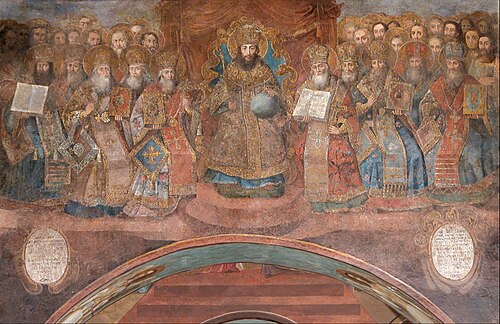
The first council of the whole Church, called by Constantine to Nicaea in 325 when the quarrel over Arius had split the East. The Church remembers the three hundred and eighteen Fathers, the number of Abraham’s household in Genesis; historians count somewhat fewer. It condemned Arius, wrote the first part of the Creed with the word homoousios at its centre, and settled that all the churches should keep Pascha on the same Sunday, apart from the Jewish Passover reckoning. Its twenty canons regulate the rights of the great sees, the readmission of the lapsed, and why no one kneels on Sundays. The council did not end the controversy; it took fifty years for the Church to receive what it had said, and that reception, more than the gathering itself, is what made it ecumenical.
Sources
- First Ecumenical Council (325 AD), the Symbol of Faith and the Canons the Acts, NPNF
- Eusebius, The Life of Constantine III.6-14 NPNF
- St. Athanasius, On the Decrees of the Council of Nicaea NPNF
- Socrates Scholasticus, Ecclesiastical History I.8 NPNF
Connections
- Arianism
- Canon Law
- Edict of Milan (313 AD)
- Emperor Constantine the Great
- Homoousios (Consubstantial)
- Nicene-Constantinopolitan Creed
- Pascha (Easter)
- St. Ambrose of Milan
- St. Athanasius the Great (c. 296-373)
- St. Gregory the Illuminator
- St. Nicholas of Myra (c. 270-343)
- St. Polychronius the Hieromartyr (4th c.)
- St. Spyridon of Trimythous
- The Apostolic Canons
- The Holy Trinity
The canons
The 20 canons of this council are on this site in Greek, with our own English translation: The First Ecumenical Council, the canons.