Theology & Dogma
The Holy Trinity
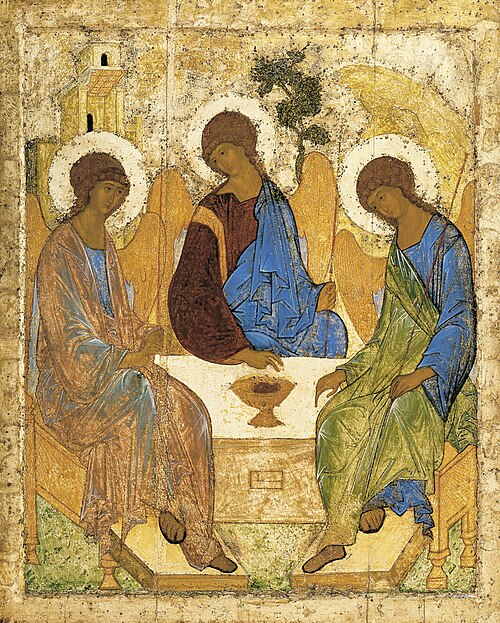
One God in three Persons, Father, Son and Holy Spirit: not three gods, and not one person wearing three masks. The three share one essence, one will and one activity, and are distinguished only by how each has His being: the Father unbegotten, the Son begotten, the Spirit proceeding. The Father is the source and cause of the other two, and that is why the Church confesses one God: its unity is a Person, not an abstraction behind the three. The doctrine was not invented and then defended; it was forced into words by the Church’s own worship, which from the beginning baptised in the one name of the three, and it was fixed at Nicaea and Constantinople against those who would have made the Son or the Spirit a creature. Every group of psalms in the services ends in the doxology to the three, and every Orthodox prayer is addressed within it. The Church is meant to be its icon: many persons, one life.
No sooner do I conceive of the One than I am illumined by the Splendour of the Three; no sooner do I distinguish Them than I am carried back to the One.
The text
The Trisagion
Holy God, Holy Mighty, Holy Immortal, have mercy on us.
Ἅγιος ὁ Θεός, Ἅγιος Ἰσχυρός, Ἅγιος Ἀθάνατος, ἐλέησον ἡμᾶς.
Sung at the Liturgy before the readings and said at the start of nearly every service and every rule of prayer. Three times, then the Glory.
Sources
- Gospel of Matthew 28:19 the Greek New Testament
- Nicene-Constantinopolitan Creed (381 AD) OCA
- St. Gregory the Theologian, Orations 27-31 the Theological Orations
- St. Gregory of Nyssa, On Not Three Gods NPNF
- St. John of Damascus, Exact Exposition of the Orthodox Faith, Book I NPNF
- St. Gregory the Theologian, Oration 40.41 NPNF
Connections
- Ecclesiology (Doctrine of the Church)
- Exact Exposition of the Orthodox Faith
- First Ecumenical Council: Nicaea I (325)
- Homoousios (Consubstantial)
- Hypostasis (Person)
- Nicene-Constantinopolitan Creed
- Ousia (Essence/Nature)
- Pentecost (Feast of the Holy Trinity)
- Perichoresis (Mutual Indwelling)
- Pneumatology (Holy Spirit)
- Rublev's Trinity Icon
- Second Ecumenical Council: Constantinople I (381)
- Sophiology
- St. Barbara the Great Martyr
- St. Gregory of Nyssa (c. 335-395)
- St. Gregory the Theologian (329-390)
- St. Gregory the Wonderworker (c. 210-270)
- St. John of Damascus (c. 676-749)
- St. Sergius of Radonezh
- St. Spyridon of Trimythous
- The Monarchy of the Father
- The Trisagion and the Trisagion Prayers
- Theophany (Epiphany): January 6