Theology & Dogma
Nicene-Constantinopolitan Creed
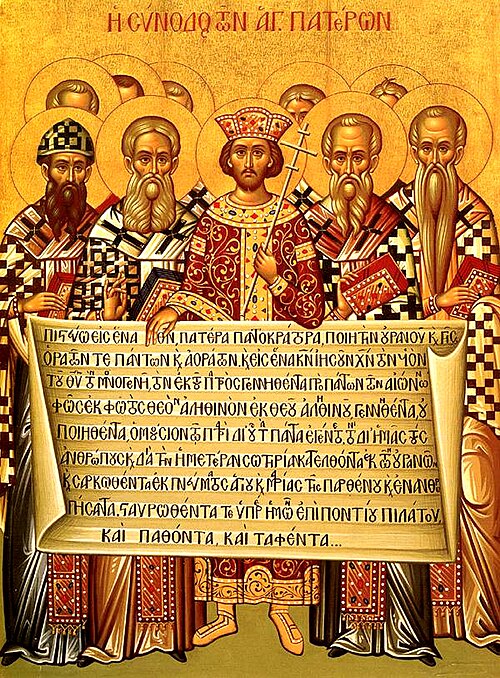
The Symbol of Faith: the confession the whole Church says, written at the First Council in 325 and completed at the Second in 381, which added the articles on the Holy Spirit, the Church, baptism, the resurrection and the life of the age to come. Chalcedon received it as the creed of the hundred and fifty Fathers, and Ephesus forbade any other. It is said at every Divine Liturgy, after the deacon cries the doors, the doors, and by every candidate for baptism. The council wrote we believe; the Church at prayer says I believe, each person confessing for themselves the faith of all. The text the Orthodox Church says has no Filioque, because nothing was ever added to it here, and it is given below in the Greek of the councils.
The text
The Symbol of Faith
I believe in one God, the Father Almighty, Maker of heaven and earth, and of all things visible and invisible;
And in one Lord Jesus Christ, the Son of God, the Only-begotten, begotten of the Father before all ages; Light of Light, true God of true God; begotten, not made; of one essence with the Father, by whom all things were made;
Who for us men and for our salvation came down from heaven, and was incarnate of the Holy Spirit and the Virgin Mary, and became man;
And was crucified for us under Pontius Pilate, and suffered, and was buried;
And arose again on the third day according to the Scriptures;
And ascended into heaven, and sitteth at the right hand of the Father;
And He shall come again with glory to judge the living and the dead, whose kingdom shall have no end.
And in the Holy Spirit, the Lord, the Giver of Life, who proceedeth from the Father; who with the Father and the Son together is worshipped and glorified; who spake by the Prophets;
In one Holy, Catholic and Apostolic Church;
I confess one baptism for the remission of sins;
I look for the resurrection of the dead,
And the life of the age to come. Amen.
Πιστεύω εἰς ἕνα Θεόν, Πατέρα, Παντοκράτορα, ποιητὴν οὐρανοῦ καὶ γῆς, ὁρατῶν τε πάντων καὶ ἀοράτων.
Καὶ εἰς ἕνα Κύριον Ἰησοῦν Χριστόν, τὸν Υἱὸν τοῦ Θεοῦ τὸν μονογενῆ, τὸν ἐκ τοῦ Πατρὸς γεννηθέντα πρὸ πάντων τῶν αἰώνων· φῶς ἐκ φωτός, Θεὸν ἀληθινὸν ἐκ Θεοῦ ἀληθινοῦ, γεννηθέντα οὐ ποιηθέντα, ὁμοούσιον τῷ Πατρί, δι᾽ οὗ τὰ πάντα ἐγένετο.
Τὸν δι᾽ ἡμᾶς τοὺς ἀνθρώπους καὶ διὰ τὴν ἡμετέραν σωτηρίαν κατελθόντα ἐκ τῶν οὐρανῶν καὶ σαρκωθέντα ἐκ Πνεύματος Ἁγίου καὶ Μαρίας τῆς Παρθένου καὶ ἐνανθρωπήσαντα.
Σταυρωθέντα τε ὑπὲρ ἡμῶν ἐπὶ Ποντίου Πιλάτου, καὶ παθόντα καὶ ταφέντα.
Καὶ ἀναστάντα τῇ τρίτῃ ἡμέρᾳ κατὰ τὰς Γραφάς.
Καὶ ἀνελθόντα εἰς τοὺς οὐρανοὺς καὶ καθεζόμενον ἐκ δεξιῶν τοῦ Πατρός.
Καὶ πάλιν ἐρχόμενον μετὰ δόξης κρῖναι ζῶντας καὶ νεκρούς, οὗ τῆς βασιλείας οὐκ ἔσται τέλος.
Καὶ εἰς τὸ Πνεῦμα τὸ Ἅγιον, τὸ Κύριον, τὸ ζωοποιόν, τὸ ἐκ τοῦ Πατρὸς ἐκπορευόμενον, τὸ σὺν Πατρὶ καὶ Υἱῷ συμπροσκυνούμενον καὶ συνδοξαζόμενον, τὸ λαλῆσαν διὰ τῶν προφητῶν.
Εἰς μίαν, Ἁγίαν, Καθολικὴν καὶ Ἀποστολικὴν Ἐκκλησίαν.
Ὁμολογῶ ἓν βάπτισμα εἰς ἄφεσιν ἁμαρτιῶν.
Προσδοκῶ ἀνάστασιν νεκρῶν.
Καὶ ζωὴν τοῦ μέλλοντος αἰῶνος. Ἀμήν.
As received from the First and Second Ecumenical Councils, 325 and 381. Given in the first person, as it is said at the Liturgy, rather than the "We believe" of the council that wrote it. There is no Filioque, because nothing was ever added to it.
Sources
- First Ecumenical Council (325 AD) the Acts, NPNF
- Second Ecumenical Council (381 AD) the Acts, NPNF
- Fourth Ecumenical Council (451 AD), the Definition of Faith
- Third Ecumenical Council (431 AD), Canon 7 the canon, in Greek and English
- St. Gregory the Theologian, Oration 31 (Fifth Theological Oration, On the Holy Spirit) the Theological Orations
Connections
- Ecclesiology (Doctrine of the Church)
- Filioque Controversy
- First Ecumenical Council: Nicaea I (325)
- Holy Baptism
- Holy Tradition
- Homoousios (Consubstantial)
- On the Holy Spirit (St Basil)
- Second Ecumenical Council: Constantinople I (381)
- St. Cyril of Jerusalem
- St. Epiphanius of Cyprus
- St. Gregory the Theologian (329-390)
- The Council of Constantinople (879-880)
- The Divine Liturgy
- The Holy Trinity
- The Monarchy of the Father
- The Second Coming of Christ