Holy Mysteries (Sacraments)
Holy Eucharist (Communion)
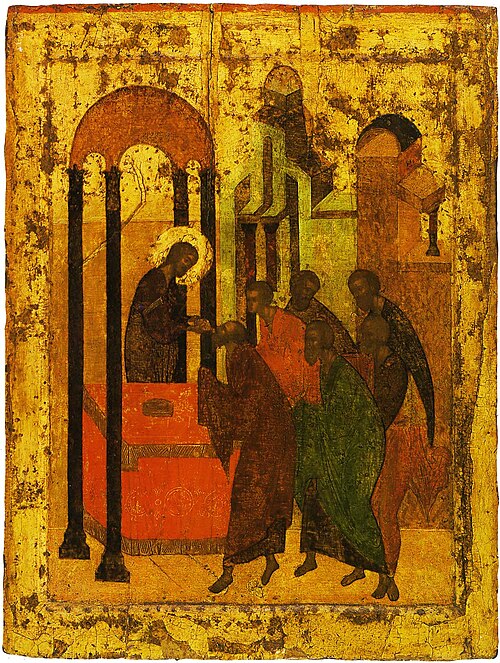
The Mystery of Christ’s Body and Blood, the centre of the Church’s life, and in the Orthodox understanding not a symbol of Christ but Christ: the bread and wine offered are changed by the Holy Spirit at the epiclesis into His true Body and Blood. The Church has generally declined to define how; the Synod of Jerusalem in 1672 used the word metousiosis, and the older and commoner word is simply change. The bread is leavened, as it always has been in the East, and warm water is poured into the chalice before communion. The faithful, infants included, receive the Body and Blood together from a spoon, having fasted from the night before and prepared by prayer and, according to local practice, confession. How often to receive has been argued in every age, and the saints have usually argued for more often.
The text
Of Thy Mystical Supper
Of Thy Mystical Supper, O Son of God, accept me today as a communicant;
for I will not speak of Thy Mystery to Thine enemies, neither will I give Thee a kiss as did Judas,
but like the thief will I confess Thee: Remember me, O Lord, in Thy Kingdom.
Τοῦ Δείπνου σου τοῦ μυστικοῦ σήμερον, Υἱὲ Θεοῦ, κοινωνόν με παράλαβε·
οὐ μὴ γὰρ τοῖς ἐχθροῖς σου τὸ μυστήριον εἴπω, οὐ φίλημά σοι δώσω καθάπερ ὁ Ἰούδας,
ἀλλ᾽ ὡς ὁ λῃστὴς ὁμολογῶ σοι· Μνήσθητί μου, Κύριε, ἐν τῇ βασιλείᾳ σου.
Said by everyone approaching the chalice, in place of the Cherubic Hymn on Great Thursday. The last line is the thief on the cross, which is the only claim anybody makes at the chalice.
Sources
- Gospel of John 6:51-58 the Greek New Testament
- St. Cyril of Jerusalem, Mystagogical Catecheses IV-V NPNF
- St. John of Damascus, Exact Exposition of the Orthodox Faith IV.13 NPNF
- St. Nicholas Cabasilas, A Commentary on the Divine Liturgy archive.org, to borrow
- Synod of Jerusalem (1672), Decree 17 the Acts and Decrees
Connections
- Ecclesiology (Doctrine of the Church)
- Fasting
- For the Life of the World (Fr. Schmemann)
- Holy Baptism
- Holy Chrismation (Confirmation)
- Holy Confession (Repentance)
- Holy Unction (Anointing of the Sick)
- Prosphora (Liturgical Bread)
- St. Cyril of Jerusalem
- St. Ignatius of Antioch (c. 35-108)
- St. John Chrysostom (c. 349-407)
- St. John of Damascus (c. 676-749)
- St. John of Kronstadt (1829-1908)
- St. Justin Martyr (c. 100-165)
- St. Nicholas Cabasilas
- The Anaphora (The Offering)
- The Didache (Teaching of the Twelve)
- The Divine Liturgy
- The Epiclesis (Calling Down the Spirit)
- The Prophet Malachi
- Theosis (Deification)