Councils and Their Canons
Seventh Ecumenical Council: Nicaea II (787)
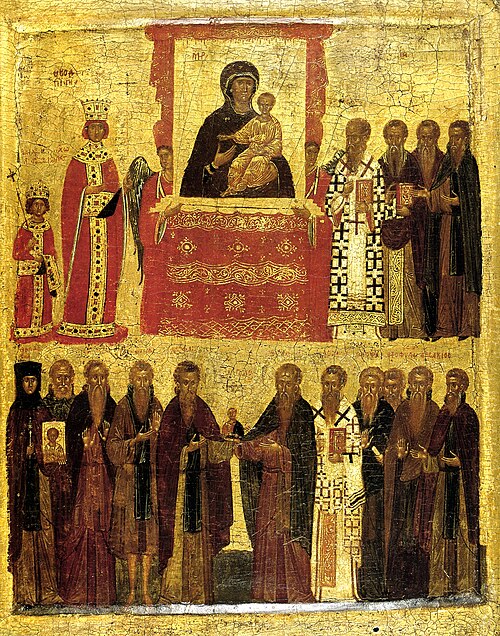
The seventh and last Ecumenical Council, which met at Nicaea in 787 under the Empress Irene and the Patriarch Tarasius, after a first attempt the year before was broken up by soldiers loyal to the iconoclasts. It defined that holy images of Christ, the Mother of God, the angels and the saints are to be set up and venerated, and drew the distinction the whole argument turned on: veneration, proskynesis, may be given to an icon, while worship, latreia, belongs to God alone; and the honour paid to the image passes to the one it shows, in St Basil’s words. Its reason is the Incarnation: God made Himself visible, and to refuse to paint Him is to deny that He was seen. Iconoclasm returned in 815 and was ended for good in 843, which the Church keeps as the Triumph of Orthodoxy.
Sources
- Seventh Ecumenical Council (787 AD), the Horos the Acts, NPNF
- St. Basil the Great, On the Holy Spirit 18.45 NPNF
- St. John of Damascus, Three Treatises on the Divine Images Fordham, the Allies translation
- St. Theodore the Studite, On the Holy Icons archive.org, to borrow
Connections
The canons
The 22 canons of this council are on this site in Greek, with our own English translation: The Seventh Ecumenical Council, the canons.