Iconography & Sacred Art
Iconoclasm
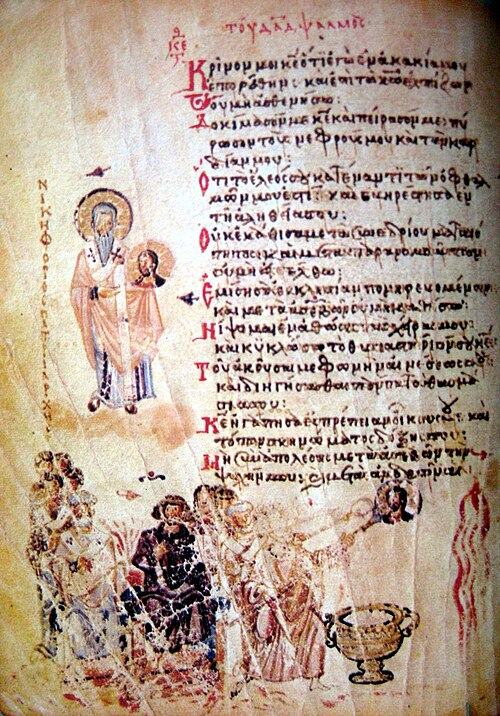
The century and more in which Byzantine emperors made war on the icons. Leo III began it in the 720s, Constantine V drove it further and had it confirmed by the council of Hieria in 754, and monks suffered most: St Stephen the New was killed in 765. The Seventh Ecumenical Council, meeting at Nicaea in 787 under the Empress Irene and St Tarasius, restored the icons, but Leo V banned them again in 815, and St Theodore the Studite led the resistance from exile. The Empress Theodora and St Methodios restored them for good in 843, the Triumph of Orthodoxy still kept on the first Sunday of Lent. The argument was about Christ: if the Word became flesh, He can be depicted, and to refuse the image is to doubt the Incarnation. St John of Damascus put it plainly: I do not venerate matter, I venerate the Creator of matter, who became matter for my sake. The honour given to the image, the council taught with St Basil, passes to the one it shows, and worship belongs to God alone.
Sources
- Seventh Ecumenical Council Acts (Nicaea II, 787 AD) the Acts, NPNF
- St. Theodore the Studite, On the Holy Icons archive.org, to borrow
- St. John of Damascus, Three Treatises on the Divine Images Fordham, the Allies translation
- Council of Hieria (754), the Horos, as read at Nicaea II the Acts, NPNF
- St. Basil the Great, On the Holy Spirit 18.45 NPNF
Connections
- Seventh Ecumenical Council: Nicaea II (787)
- St. Andrew in Krisei (d. 767)
- St. Basil the Great (330-379)
- St. Catherine's Monastery (Sinai)
- St. Germanus of Constantinople
- St. John of Damascus (c. 676-749)
- St. Methodius the Confessor
- St. Theodore the Studite (759-826)
- The Byzantine Empire & Orthodoxy
- The Image Not Made by Hands (Mandylion)
- The Incarnation
- The Triumph of Orthodoxy
- Theology of Icons