Iconography & Sacred Art
Theology of Icons
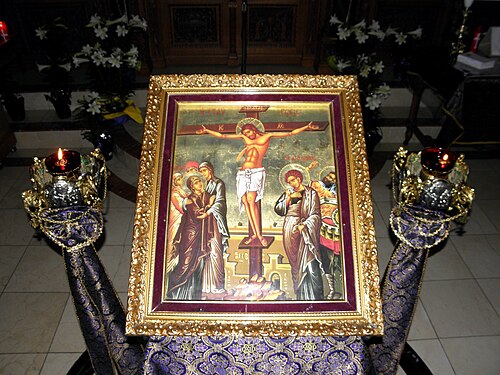
Icons are not mere religious art: they are 'theology in color,' windows into the heavenly reality. The veneration of icons is grounded in the Incarnation: because God became visible in Christ, it is possible and proper to depict Him. 'He who has seen Me has seen the Father' (John 14:9). The honor paid to the image (eikon) passes to the prototype (prototypon).
Sources
- St. John of Damascus, Three Treatises on the Divine Images Fordham, the Allies translation
- Seventh Ecumenical Council (787) the Acts, NPNF
- Leonid Ouspensky, Theology of the Icon
Connections
- Christ Pantocrator (Icon Type)
- Exact Exposition of the Orthodox Faith
- Hagia Sophia
- Holy Tradition
- Iconoclasm
- Image & Likeness of God
- Seventh Ecumenical Council: Nicaea II (787)
- St. Andrew in Krisei (d. 767)
- St. John of Damascus (c. 676-749)
- St. Tarasius of Constantinople
- St. Theodore the Studite (759-826)
- The Cross (Symbol & Object)
- The Deesis
- The Descent into Hades
- The Image Not Made by Hands (Mandylion)
- The Incarnation
- The Painter’s Manual (Hermeneia)
- The Quinisext Council (Trullo, 692)
- The Triumph of Orthodoxy
- Theotokos Icon Types